
How to Calculate EMI: Formula, Examples & Monthly Loan Payments
Learn how to calculate EMI using the monthly loan payment formula. Follow a verified example, compare repayment periods, understand principal versus interest, and calculate EMI in Excel.
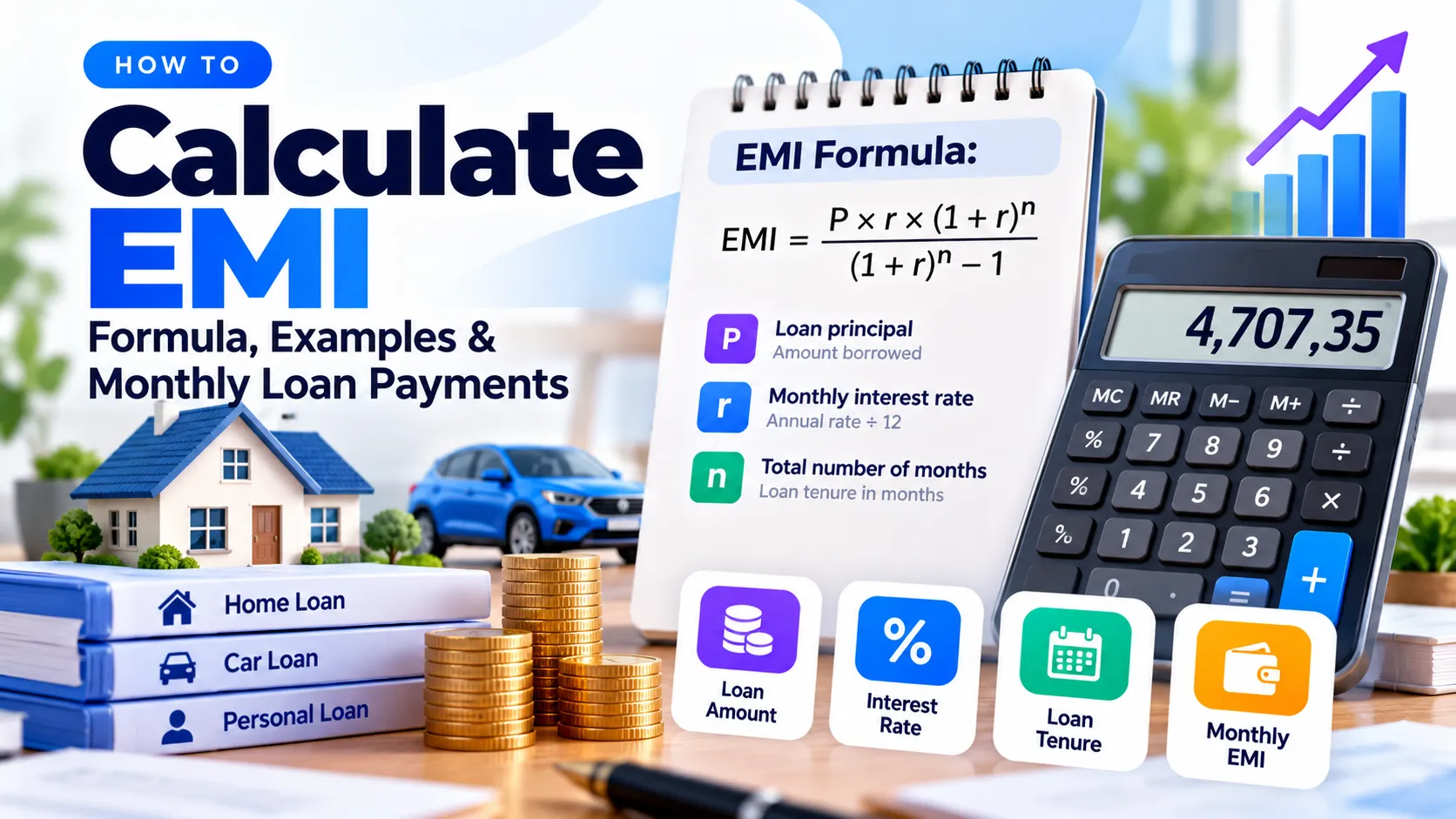
Taking out a loan is about more than knowing how much money you can borrow. The number that often matters most to your monthly budget is the installment you'll have to pay back.
That's where EMI comes in.
EMI stands for Equated Monthly Installment (also spelled Instalment). It's the fixed monthly payment commonly used to repay a loan over a specified period. Each payment typically includes part of the principal and part of the interest.
But how do you calculate EMI? Why does a longer loan term reduce your monthly payment while increasing your total interest? And how can two loans with similar installments cost very different amounts overall?
This guide explains the EMI formula, walks through a verified calculation, compares loan terms and interest rates, and shows you how to calculate monthly payments manually, in Excel, or with a free online calculator.
How to Calculate EMI: Quick Answer
For a standard fixed-rate loan with monthly payments and interest calculated on the reducing balance, use:
EMI = P × r × (1 + r)^n / [(1 + r)^n − 1]
Where:
P = Loan principal, or the amount borrowed
r = Monthly interest rate, expressed as a decimal
n = Total number of monthly payments
To calculate EMI:
Identify the loan amount.
Convert the annual interest rate into a monthly decimal rate.
Convert the loan tenure into months.
Substitute the values into the formula.
Calculate the monthly installment.
Multiply the EMI by the number of months to estimate total repayment.
Subtract the original principal to find total interest.
For a faster estimate, use Nimzoa's Loan / EMI Calculator.
Important: This formula assumes a conventional fixed-rate, fully amortizing loan. Actual lender calculations may differ because of fees, compounding conventions, variable rates, payment dates, or other terms.
What Is EMI in a Loan?
EMI is the regular monthly amount a borrower pays toward a loan.
In a typical reducing-balance loan, the payment amount stays the same, but the proportions allocated to principal and interest change over time.
At the beginning, the outstanding balance is relatively high, so more of each payment goes toward interest.
As the principal decreases, the interest portion becomes smaller and more of the payment goes toward reducing the remaining debt.
Principal vs. Interest: What's the Difference?
Principal is the original amount borrowed.
Interest is the cost charged by the lender for providing the loan.
For example, if you borrow 100,000, that amount is your starting principal.
If your total repayments over the loan term add up to 112,976.33, then approximately 12,976.33 represents interest under the assumptions used in this guide.
The total cost of borrowing may be higher if the lender charges additional fees or requires insurance.
Does EMI Always Stay the Same?
Not necessarily.
For a fixed-rate, fully amortizing loan with regular monthly payments, the EMI is generally constant.
For variable-rate loans, the payment amount or remaining tenure may change when the interest rate changes.
Some loans also use flat-rate interest, balloon payments, or other repayment structures.
Always check the lender's repayment schedule rather than assuming every loan follows the same formula.
EMI Calculation Formula Explained
The standard EMI formula is:
EMI = P × r × (1 + r)^n / [(1 + r)^n − 1]
The formula calculates a payment designed to repay the principal and accrued interest over the agreed number of periods.
Step 1: Find the Loan Principal
The principal is the amount you're borrowing.
Suppose the loan amount is:
P = 100,000
We'll use generic currency units so the example works regardless of whether you're calculating in rupees, dollars, dirhams, or another currency.
Step 2: Convert Annual Interest into a Monthly Rate
Suppose the quoted annual nominal interest rate is 12%, with interest calculated monthly.
Divide 12% by 12:
12% ÷ 12 = 1% per month
Then convert the percentage into decimal form:
r = 0.01
For this particular calculation, the monthly rate is 1%.
Do not automatically divide every quoted annual rate by 12. A lender may quote an effective annual rate, APR, or another measure that needs different treatment.
Step 3: Convert the Tenure into Months
Suppose the loan lasts two years.
2 × 12 = 24 months
Therefore:
n = 24
Step 4: Apply the Formula
Substitute the values:
EMI = 100,000 × 0.01 × (1.01)^24 / [(1.01)^24 − 1]
The result is:
Monthly EMI ≈ 4,707.35
Step 5: Calculate Total Repayment
Multiply the unrounded monthly EMI by 24:
Total repayment ≈ 112,976.33
Step 6: Calculate Total Interest
Subtract the original loan principal:
112,976.33 − 100,000 = 12,976.33
The result is a monthly payment of approximately 4,707.35 and total interest of approximately 12,976.33.
Small differences may appear when a lender rounds each installment or adjusts the final payment.
EMI Calculation Example: What Happens Each Month?
Knowing the EMI amount is useful, but understanding where the money goes is even more important.
Let's examine the first two payments of our example loan.
Month 1
Starting loan balance: 100,000
Monthly interest: 100,000 × 1% = 1,000
EMI: 4,707.35
Principal repaid: 4,707.35 − 1,000 = approximately 3,707.35
Remaining balance: approximately 96,292.65
Month 2
The interest is now calculated on the lower outstanding balance.
Monthly interest: approximately 962.93
EMI: approximately 4,707.35
Principal repaid: approximately 3,744.42
Remaining balance: approximately 92,548.23
Notice the pattern: the EMI stays approximately the same, but the interest portion decreases while the principal portion increases.
This is the basic idea behind a loan amortization schedule.
How Loan Tenure Affects EMI and Total Interest
One of the most common borrowing mistakes is choosing a longer repayment period simply because the monthly EMI looks more affordable.
A longer tenure usually reduces the required monthly payment, but it can significantly increase total interest.
Consider a 100,000 loan at a fixed nominal annual interest rate of 12%, calculated monthly.
Loan tenure | Monthly EMI | Total interest |
|---|---|---|
12 months | 8,884.88 | 6,618.55 |
24 months | 4,707.35 | 12,976.33 |
36 months | 3,321.43 | 19,571.48 |
Values are approximate and calculated from unrounded installments.
What Does This Comparison Tell Us?
The 36-month loan has the lowest monthly EMI.
However, it also produces the highest total interest among these three options.
The 12-month loan costs less in interest but requires a much larger monthly payment.
The most appropriate tenure depends on your cash flow, other financial obligations, emergency savings, and the lender's terms.
A lower EMI does not necessarily mean a cheaper loan.
How Interest Rates Change Your Monthly Payment
Even a few percentage points can make a meaningful difference.
Let's keep the loan principal at 100,000 and the tenure at 24 months.
Annual nominal rate | Approx. monthly EMI |
|---|---|
8% | 4,522.73 |
12% | 4,707.35 |
16% | 4,896.31 |
The payment rises as the interest rate increases.
But comparing loans based only on the headline interest rate can be misleading.
Two lenders may quote similar rates while charging different processing fees, insurance premiums, or other costs.
When comparing actual offers, look for a consistent measure of the total borrowing cost, such as APR or an equivalent disclosure where applicable.
Flat Interest vs. Reducing-Balance Interest
This distinction is essential because two loans advertised at the same annual percentage can have very different costs.
What Is Reducing-Balance Interest?
Interest is calculated on the outstanding principal.
As the loan balance falls, the interest charged for each period generally decreases.
The EMI formula explained above applies to a standard fixed-rate reducing-balance structure.
What Is Flat-Rate Interest?
Under a simple flat-rate method, interest is calculated on the original principal for the entire stated loan period.
For example, on a 100,000 loan at a flat rate of 12% annually for two years:
Total flat interest = 100,000 × 12% × 2 = 24,000
Total repayment = 124,000
Monthly payment = 124,000 ÷ 24 = 5,166.67
Compare that with our reducing-balance example at a nominal 12% annual rate:
Flat-rate payment: approximately 5,166.67 per month
Reducing-balance EMI: approximately 4,707.35 per month
These figures are not equivalent borrowing-cost quotes. They illustrate why the method used to calculate interest matters.
Before accepting a loan, ask whether the quoted rate is flat, reducing-balance, nominal, or effective.
How to Calculate EMI in Excel or Google Sheets
You don't need to calculate exponents manually every time.
Microsoft Excel and Google Sheets include a function called PMT that can calculate the regular payment for a fixed-rate loan.
Excel EMI Formula
For a loan of 100,000 at 12% annual nominal interest over 24 months:
=PMT(12%/12,24,-100000)
The result is approximately:
4,707.35
The negative principal makes the payment appear as a positive value.
Using Spreadsheet Cells
Suppose your spreadsheet contains:
Cell | Value |
|---|---|
B2 | 100000 |
B3 | 12% |
B4 | 24 |
Use:
=PMT(B3/12,B4,-B2)
This approach makes it easy to change the loan amount, interest rate, or tenure.
How to Calculate Total Interest in Excel
If the EMI result is in B5:
=B5*B4-B2
This estimates the total interest under the fixed-rate assumptions.
What If the Interest Rate Is Zero?
The standard EMI formula contains a division that becomes undefined when the periodic rate is zero.
For a genuine zero-interest loan with no other financing charges:
Monthly payment = Principal ÷ Number of payments
For example, 100,000 divided by 20 months gives 5,000 per month.
How to Calculate Monthly Loan Payments Without a Spreadsheet
You can use a scientific calculator and the EMI formula, but an online calculator is generally quicker.
Open Nimzoa's Loan / EMI Calculator, enter the relevant loan details using the available controls, and review the calculated payment.
When comparing multiple loans, keep the assumptions consistent.
For example, compare loans using the same principal and repayment term if your goal is to isolate the effect of different interest rates.
If you're evaluating home financing, explore Nimzoa's Mortgage Calculator for a mortgage-focused calculation.
EMI for Personal Loans, Car Loans, and Home Loans
The basic amortizing-payment formula can apply to many loan types, but the terms and additional costs may differ.
Personal Loan EMI
Personal loans may have shorter repayment periods and different interest rates depending on the lender and borrower.
Check whether the loan includes processing fees, early repayment charges, or compulsory add-ons.
Car Loan EMI
Vehicle financing may involve a down payment, financed amount, insurance, registration costs, or a final balloon payment.
The amount financed—not necessarily the vehicle's full purchase price—is the principal used in the standard EMI calculation.
Home Loan EMI
Mortgage payments may depend on the interest-rate structure, loan tenure, financed amount, and additional housing-related costs.
Property taxes, insurance, and other housing expenses may not be included in a basic principal-and-interest EMI calculation.
Use the Mortgage Calculator when evaluating a home-loan scenario, and review the lender's complete payment disclosures.
How Much EMI Can You Afford?
A loan calculator can tell you what a monthly installment would be.
It cannot, by itself, tell you whether that installment is financially comfortable.
Before taking on a new payment, consider:
Your reliable monthly income
Existing debt repayments
Essential household expenses
Emergency savings
Irregular or seasonal expenses
Potential interest-rate changes
Other costs associated with the loan
For example, a monthly EMI may appear manageable when compared with gross income, but less comfortable after taxes, rent, utilities, and existing debt payments.
Avoid relying on a universal affordability percentage without considering your circumstances and the lending rules that apply to you.
If you need to work out a percentage of your income, use Nimzoa's Percentage Calculator.
How to Reduce Your EMI
If your estimated installment is higher than expected, several changes may reduce it.
Borrow Less
A smaller principal generally produces a lower EMI when the rate and tenure remain unchanged.
Increasing a down payment or reducing the purchase amount may help.
Compare Interest Rates
A lower rate can reduce the monthly payment and total interest, assuming comparable loan structures and fees.
Compare the overall cost rather than only the advertised rate.
Consider a Longer Tenure
A longer term can reduce the monthly installment, but it typically increases total interest.
Use this option carefully and compare the full repayment amount.
Review Refinancing Options
Refinancing may change the interest rate, term, or payment structure.
However, refinancing fees, early settlement charges, and the new total repayment amount must be considered.
Understand Prepayments
Paying additional principal may reduce total interest or shorten the loan term, depending on the agreement.
Some lenders recalculate EMI after a prepayment, while others keep the EMI unchanged and reduce the remaining tenure.
Check the lender's rules and charges before making extra payments.
Common EMI Calculation Mistakes
Mistake 1: Using the Annual Rate Directly
If the formula expects a monthly rate, entering 12 instead of 0.01 for a 12% nominal annual rate produces an incorrect result.
Mistake 2: Entering Years Instead of Months
A two-year loan generally means 24 monthly payments, not two.
Mistake 3: Ignoring Fees
The basic EMI formula does not automatically include processing fees, insurance, taxes, or other charges.
Mistake 4: Comparing Flat and Reducing Rates as If They Were Equal
The calculation methods differ, so identical advertised percentages may not represent identical borrowing costs.
Mistake 5: Looking Only at the Monthly EMI
A smaller installment can hide a much larger total repayment.
Always compare both.
Mistake 6: Treating an Estimate as a Lender Quote
A calculator result is an estimate based on the inputs and assumptions.
The lender's official repayment schedule and agreement determine the actual obligation.
EMI vs. Compound Interest: What's the Difference?
EMI describes a repayment structure.
Compound interest describes how interest may accumulate when interest is added to a balance and earns further interest.
They are related financial concepts but not interchangeable.
A standard amortizing loan uses periodic interest calculations and scheduled payments to reduce the balance.
For educational examples involving interest growth rather than loan repayment, explore Nimzoa's Compound Interest Calculator.
Frequently Asked Questions
What is the formula for EMI?
For a standard fixed-rate reducing-balance loan, EMI = P × r × (1 + r)^n / [(1 + r)^n − 1], where P is principal, r is the monthly rate, and n is the number of monthly payments.
How do I calculate EMI manually?
Convert the annual nominal rate into a monthly decimal rate, convert the tenure into months, and apply the EMI formula. Check that the loan follows the assumed interest and repayment structure.
What is EMI on a 100,000 loan at 12% for two years?
Under a fixed nominal annual rate of 12% with monthly reducing-balance interest and 24 end-of-month payments, the EMI is approximately 4,707.35.
Does a longer loan tenure reduce EMI?
Usually yes, when other terms remain unchanged. However, a longer tenure generally increases the total interest paid.
Is EMI the same as interest?
No. EMI is the total scheduled installment, which generally includes both principal repayment and interest.
How can I calculate EMI in Excel?
Use the PMT function. For example, =PMT(12%/12,24,-100000) calculates a monthly payment of approximately 4,707.35.
Why is my bank's EMI different from an online calculator?
Differences can arise from the quoted rate type, payment dates, compounding method, fees, rounding, variable rates, or the lender's specific loan structure.
Can I calculate EMI with zero interest?
Yes. For a genuine zero-interest loan with equal monthly payments and no additional financing charges, divide the principal by the number of payments.
What is the difference between flat and reducing-balance interest?
Flat interest is commonly calculated using the original principal, while reducing-balance interest is calculated using the outstanding principal. Their quoted percentages are not directly equivalent.
Is a lower EMI always better?
No. A lower EMI may come from a longer tenure that increases the total interest paid. Compare affordability and overall borrowing cost.
Can I pay more than my EMI?
Some loan agreements permit additional principal payments. Their effect on the EMI, tenure, and total interest depends on the lender's rules and any prepayment charges.
Can an EMI calculator tell me whether a loan will be approved?
No. An EMI calculator estimates payments. Loan approval depends on the lender's eligibility, credit, income, affordability, and other requirements.
Final Checklist Before Choosing a Loan
Before accepting a loan offer, confirm:
The actual amount you will receive
The principal used for EMI calculation
Whether the rate is fixed or variable
Whether the quoted rate is flat or reducing-balance
The number and timing of payments
The estimated monthly EMI
The total interest and repayment amount
Any fees, insurance, or additional charges
Prepayment and late-payment conditions
The lender's official repayment schedule
A few minutes spent understanding these details can make a significant difference to the total cost of borrowing.
Calculate Your Monthly EMI with Nimzoa
The EMI formula helps you understand how loan amount, interest rate, and tenure work together.
But you don't need to calculate every loan scenario by hand.
Use Nimzoa's Loan / EMI Calculator to estimate your monthly payment and compare different borrowing scenarios.
You can also explore the Mortgage Calculator for home-financing calculations and the Percentage Calculator for everyday financial percentages.
Remember: the right loan is not simply the one with the lowest EMI. It's one whose full terms and repayment obligations you understand and can manage.
Educational notice: This guide provides general financial information and illustrative calculations, not personalized financial advice. Actual loan terms, fees, rates, and repayment amounts depend on your lender and agreement.
Related articles

How to Reduce Image Size Without Losing Quality: JPG, PNG & WebP Guide
Learn how to reduce image size without making photos blurry. Compare JPG, PNG and WebP, compress images to 100 KB, resize correctly, and prepare files for websites, forms and email.

How to Edit a PDF for Free: 9 Practical Fixes That Actually Work
Need to edit a PDF for free? Learn nine practical ways to add text, merge, split, remove, rotate, compress, number, and convert PDF pages—plus what to do with scanned or locked files.