
Water Displacement Method: How to Measure Volume and Density of Irregular Objects
Learn how to measure the volume of irregular objects using water displacement, calculate density from mass and volume, and avoid common experiment mistakes.
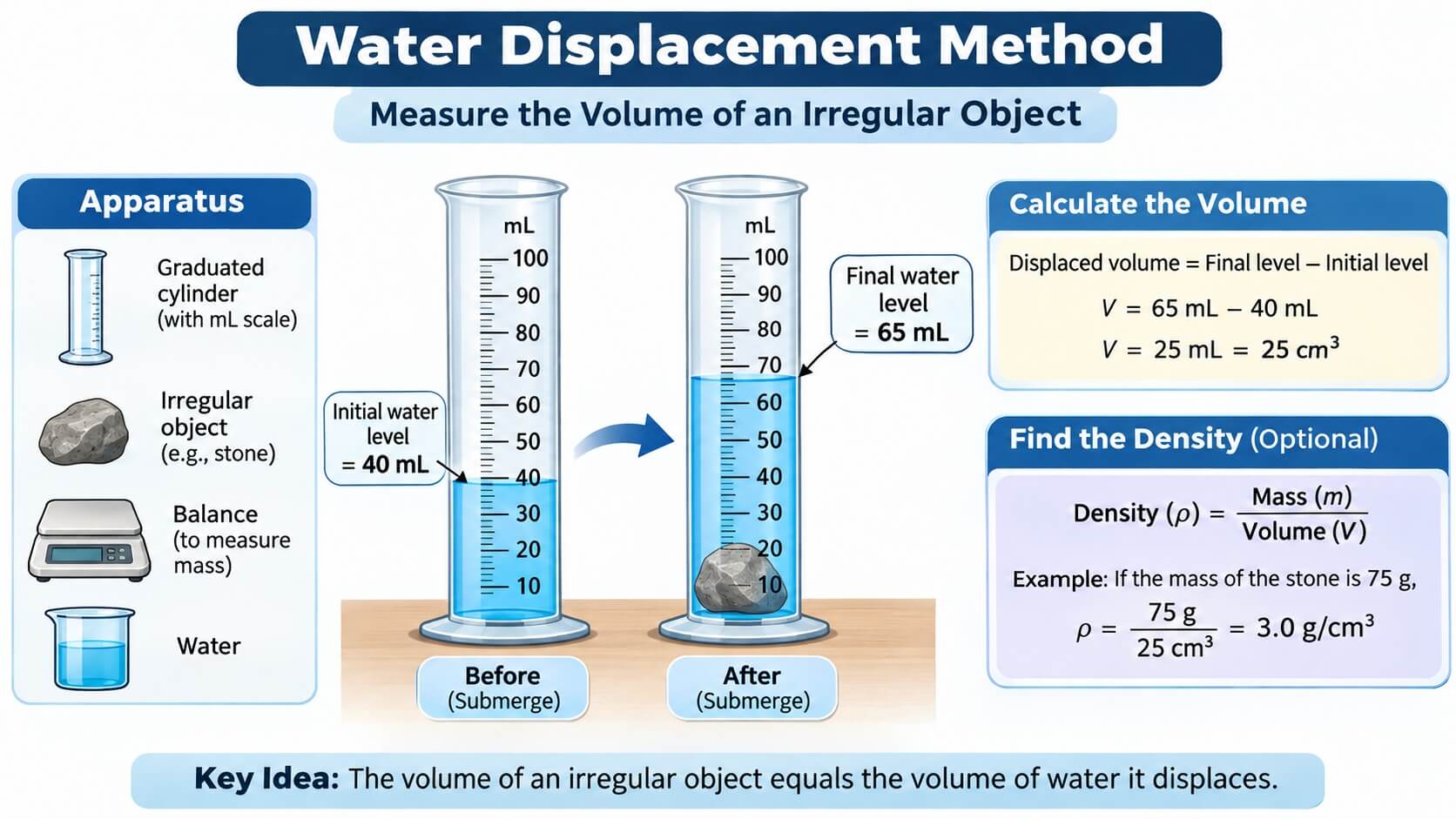
Imagine finding a small stone and wanting to know its volume. You cannot easily measure its length, width, and height because the stone has an uneven surface. Yet you can determine its volume using a graduated cylinder, some water, and a simple measurement technique.
This technique is called the water displacement method.
Water displacement is widely used in school science experiments and laboratory measurements to find the volume of solid objects with irregular shapes. Once you know the object's volume and mass, you can also calculate its density.
In this guide, you'll learn how the water displacement method works, how to measure volume accurately, how to calculate density from your results, and how to avoid common experimental errors.
What Is the Water Displacement Method?
The water displacement method is a technique for measuring the volume of an object by observing how much the water level rises when the object is fully submerged.
Instead of calculating volume from geometric dimensions, you measure the volume of water displaced by the object.
For example, suppose a graduated cylinder initially contains 40 mL of water. After you carefully submerge a small stone, the reading increases to 65 mL.
The difference is:
65 − 40 = 25 mL
The stone occupies 25 mL of volume, equivalent to 25 cm³.
This method is particularly useful for objects whose shapes cannot be represented accurately by simple geometric formulas.
Why Does Water Displacement Work?
Water displacement relies on a basic physical principle: a submerged solid occupies space that water cannot occupy at the same time.
When an object is placed in water, it displaces water corresponding to the volume of its submerged portion.
If the object is completely submerged and no air is trapped, the displaced volume equals the object's external volume.
The concept is related to Archimedes' principle, which explains the buoyant force acting on objects immersed in fluids.
However, measuring volume by displacement and calculating buoyant force are different applications of the underlying physics.
Water Displacement Formula for Finding the Volume of an Irregular Object
The formula is:
Object Volume = Final Water Volume − Initial Water Volume
Using symbols:
V = V₂ − V₁
Where:
V = volume of the submerged object
V₁ = initial water reading
V₂ = final water reading
Example: Calculate the Volume of a Small Rock
Suppose your measurements are:
Measurement | Reading |
|---|---|
Initial water level | 35 mL |
Final water level | 58 mL |
Displaced water | 23 mL |
Apply the formula:
V = 58 − 35
Object volume = 23 mL = 23 cm³
You can use this volume in a density calculation if you also know the object's mass.
How to Measure the Volume of an Irregular Object Using Water Displacement
You don't need complicated laboratory equipment to perform a basic water displacement experiment.
Equipment Needed for a Water Displacement Experiment
Gather the following:
A graduated cylinder large enough for the object
Clean water
A small solid object, such as a stone or metal sample
A balance or digital scale if you also want to measure density
A thin thread, if needed to lower the object safely
Paper or a notebook to record measurements
Choose an object that does not dissolve, react with water, or absorb a significant amount of water during the experiment.
Step 1: Add Water to the Graduated Cylinder
Pour enough water into the cylinder to cover the object once submerged.
The cylinder should also have sufficient space to accommodate the resulting rise in water level without overflowing.
Place the cylinder on a flat, stable surface.
Step 2: Record the Initial Water Volume
Read the water level at eye level.
For water in a clean glass or plastic graduated cylinder, the surface commonly forms a concave meniscus.
Read the bottom of that meniscus according to the cylinder's measurement instructions.
Suppose the initial reading is 50 mL.
Step 3: Submerge the Object Completely
Lower the object slowly into the water.
Avoid splashing, trapping air bubbles, or allowing the water to overflow.
If the object floats, the simple rise in water level represents only its submerged volume. Fully submerging a floating object requires an additional method that accounts for any sinker used.
Step 4: Record the Final Water Volume
After the water settles, read the new level at eye height.
Suppose the final reading is 78 mL.
Step 5: Calculate the Displaced Water Volume
Subtract the initial reading from the final reading:
78 − 50 = 28 mL
Therefore:
Volume of the object = 28 cm³
Remember that 1 mL is exactly equivalent to 1 cm³.
How to Find the Density of an Irregular Object Using Water Displacement
Water displacement measures volume, not density directly.
To determine density, you also need the object's mass.
The density formula is:
Density = Mass ÷ Volume
Or:
ρ = m / V
Where:
ρ = density
m = mass
V = volume
Worked Example: Finding the Density of a Stone
A student measures the mass of a stone using a digital balance.
The mass is 84 g.
The student then performs a water displacement experiment.
Measurement | Value |
|---|---|
Mass of stone | 84 g |
Initial water level | 45 mL |
Final water level | 75 mL |
Stone volume | 30 cm³ |
First, calculate volume:
75 − 45 = 30 cm³
Next, calculate density:
84 ÷ 30 = 2.8 g/cm³
The stone's calculated density is 2.8 grams per cubic centimeter.
You can verify this result using the Nimzoa Density Calculator. Select the option to calculate density, enter the mass and volume, and choose compatible units.
How to Convert the Result to kg/m³
Many science and engineering references use kilograms per cubic meter rather than grams per cubic centimeter.
The conversion is:
1 g/cm³ = 1,000 kg/m³
Therefore:
2.8 × 1,000 = 2,800 kg/m³
Both values describe the same density.
Water Displacement Method Examples With Different Objects
The procedure is similar for many small, solid objects, but the accuracy depends on the object's physical properties.
Example 1: Measuring the Volume of a Metal Bolt
A metal bolt is too irregular to calculate its volume accurately using length and width alone.
The measurements are:
Initial water volume: 60 mL
Final water volume: 67.5 mL
Displaced volume:
67.5 − 60 = 7.5 cm³
If the bolt has a mass of 58.5 g:
Density = 58.5 ÷ 7.5
Density = 7.8 g/cm³
This value is within the approximate density range of many steels, although density alone cannot confirm the bolt's exact material composition.
Example 2: Measuring a Small Glass Marble
A glass marble is spherical, so its volume could also be calculated geometrically.
However, water displacement provides a useful experimental comparison.
Suppose:
Initial water level: 25 mL
Final water level: 30 mL
The measured marble volume is:
30 − 25 = 5 cm³
If its mass is 12.5 g:
Density = 12.5 ÷ 5
Density = 2.5 g/cm³
The experiment gives an estimate consistent with the density of many common glasses.
Example 3: Finding the Volume of Several Small Pebbles
Sometimes one pebble is too small to cause a clearly measurable change in a graduated cylinder.
You can measure several similar pebbles together.
Suppose 10 pebbles increase the water level from 40 mL to 58 mL.
Combined volume:
58 − 40 = 18 cm³
Average volume per pebble:
18 ÷ 10 = 1.8 cm³
This provides an average volume, not the exact volume of each individual pebble.
Measuring several small objects together can reduce the relative impact of reading uncertainty, provided the objects are fully submerged and no air is trapped.
Water Displacement Experiment Results Table
A simple data table makes your measurements easier to check and compare.
The following values are illustrative examples, not results from an actual laboratory experiment.
Object | Initial water (mL) | Final water (mL) | Volume (cm³) |
|---|---|---|---|
Small stone | 30 | 48 | 18 |
Metal bolt | 40 | 47.5 | 7.5 |
Glass marble | 25 | 30 | 5 |
Ceramic piece | 50 | 62 | 12 |
Several pebbles | 40 | 58 | 18 |
For each object, the volume is the difference between the final and initial readings.
When performing a real experiment, record measurements using the precision supported by your graduated cylinder.
How Accurate Is the Water Displacement Method?
Water displacement can provide reliable volume measurements when the equipment and procedure are suitable.
However, its accuracy depends on several factors.
Graduated Cylinder Resolution
A cylinder marked in 1 mL increments generally cannot provide the same measurement precision as equipment with finer graduations.
Choose a cylinder appropriate for the expected displacement.
Meniscus Reading Errors
Reading the water surface from above or below eye level can introduce parallax errors.
Read the meniscus consistently and use the correct graduation marks.
Trapped Air Bubbles
Air bubbles attached to the object occupy additional volume and can make the measured displacement too large.
Lower the object slowly and remove visible bubbles where practical.
Water Loss During Submersion
Splashing or overflowing reduces the amount of water remaining in the cylinder and can distort the result.
Use a sufficiently large cylinder and lower the object carefully.
Water Absorption
Porous objects may absorb water, which can affect the measured displacement.
The method is best suited to objects that do not significantly absorb water during measurement.
Common Water Displacement Method Mistakes and How to Avoid Them
Common mistake | Why it matters | Better approach |
|---|---|---|
Reading the cylinder from an angle | Causes parallax error | Read at eye level |
Leaving part of the object above water | Measures only submerged volume | Fully submerge the object |
Trapping air bubbles | Adds apparent displaced volume | Remove visible bubbles |
Using a cylinder that is too large | Small changes become hard to read | Choose suitable graduations |
Allowing water to overflow | Makes the volume difference unreliable | Leave sufficient space |
Using water-soluble materials | Changes the object during measurement | Choose another measurement method |
Confusing mL and liters | Produces incorrect calculations | Convert units before calculating |
Can You Use Water Displacement to Measure a Floating Object?
Yes, but the standard procedure requires modification.
A floating object displaces water equal in weight to the object, rather than necessarily displacing water equal to its entire volume.
To measure the object's full volume, you can use a sinker to hold it underwater.
A simplified procedure is:
Measure the displacement caused by the sinker alone.
Measure the displacement with both the sinker and floating object fully submerged.
Subtract the sinker's displacement from the combined displacement.
For example:
Sinker displacement: 12 mL
Combined displacement: 32 mL
Floating object's volume:
32 − 12 = 20 cm³
The procedure assumes the sinker and object remain fully submerged without trapped air or water loss.
Water Displacement vs. Geometric Volume Measurement
Water displacement is not always the best way to measure volume.
For objects with simple, regular shapes, geometric formulas may be faster and more precise.
Measurement method | Best suited for | Example |
|---|---|---|
Water displacement | Irregular, water-compatible solids | Stone |
Length × width × height | Rectangular solids | Wooden block |
πr²h | Cylinders | Metal rod |
4/3 πr³ | Spheres | Ball bearing |
Overflow displacement | Objects unsuitable for a standard graduated cylinder | Larger irregular solid |
The best method depends on the object's shape, size, material and required precision.
What Is the Difference Between Water Displacement and Archimedes' Principle?
The two concepts are closely related but answer different questions.
Water displacement is used to determine how much fluid volume an object displaces.
Archimedes' principle describes the upward buoyant force acting on an object immersed in a fluid.
That buoyant force equals the weight of the displaced fluid.
For a fully submerged object, the displaced fluid volume equals the object's external volume.
For a freely floating object, only the submerged portion displaces water.
Understanding this distinction helps explain why floating objects require additional care when measuring their total volume.
Frequently Asked Questions About the Water Displacement Method
What is the water displacement method in simple words?
It is a way to measure an object's volume by checking how much the water level rises when the object is placed in water.
How do you find the volume of an irregular object using water displacement?
Record the initial water level, fully submerge the object, record the final water level, and subtract the initial reading from the final reading.
How do you calculate density after measuring water displacement?
Measure the object's mass and divide it by the volume obtained from water displacement.
Why is water displacement useful for irregular shapes?
Irregular objects are difficult to measure using ordinary geometric formulas. Water displacement measures their volume without requiring a simple geometric shape.
Is 1 mL equal to 1 cm³?
Yes. One milliliter is exactly equal to one cubic centimeter.
Can water displacement measure the volume of wood?
It can, but floating and water absorption create complications. A sinker method may be needed, and measurements should account for water absorption.
What happens if an air bubble sticks to the object?
The bubble occupies space and can increase the apparent displaced volume, causing an overestimate.
Can water displacement measure density without a scale?
Not by itself. Water displacement gives volume. Calculating density also requires mass.
Is water displacement accurate for very small objects?
It can be, but the cylinder must have suitable measurement resolution. Measuring several similar objects together may help when individual displacements are too small to read reliably.
Calculate Density From Your Water Displacement Results
Once you've measured an object's mass and displacement volume, calculating density is straightforward.
For example:
Mass = 96 g
Initial water level = 40 mL
Final water level = 72 mL
Object volume:
72 − 40 = 32 cm³
Density:
96 ÷ 32 = 3 g/cm³
Instead of repeating the calculation manually, use the free Nimzoa Density Calculator to check your answer and convert between supported density units.
The calculator is especially helpful when working with different mass and volume measurements.
Conclusion: When Should You Use the Water Displacement Method?
The water displacement method is a practical way to measure the volume of small, irregularly shaped objects that can be safely submerged in water.
The process is simple: measure the starting water level, submerge the object, measure the final level, and calculate the difference.
If you also measure the object's mass, you can calculate its density using the formula:
Density = Mass ÷ Volume
For reliable results, use suitable equipment, avoid trapped air, read the meniscus correctly, and consider whether the object floats, dissolves, or absorbs water.
With careful measurements, water displacement provides a useful bridge between basic classroom experiments and practical density calculations.
References and Further Reading
For additional background on volume, density, buoyancy and scientific measurement:
Related articles

How to Calculate EMI: Formula, Examples & Monthly Loan Payments
Learn how to calculate EMI using the monthly loan payment formula. Follow a verified example, compare repayment periods, understand principal versus interest, and calculate EMI in Excel.

How to Reduce Image Size Without Losing Quality: JPG, PNG & WebP Guide
Learn how to reduce image size without making photos blurry. Compare JPG, PNG and WebP, compress images to 100 KB, resize correctly, and prepare files for websites, forms and email.

How to Edit a PDF for Free: 9 Practical Fixes That Actually Work
Need to edit a PDF for free? Learn nine practical ways to add text, merge, split, remove, rotate, compress, number, and convert PDF pages—plus what to do with scanned or locked files.